Global Positioning Systems (GPS)

Wednesday, December 22, 2010

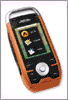
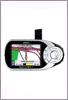
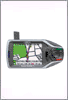
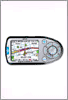
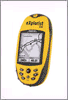
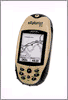
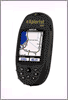
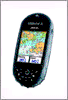
How to select a handheld GPS

For a last-minute gift idea, especially if your special someone likes the outdoors or travel, consider a handheld GPS unit, the super-compass for hikers, backpackers, bicyclists, anglers and travelers.

What - GPS stands for global positioning system. A GPS unit communicates with a community of satellites to calibrate your location and destination.

How much -Generally $50 to $600 at most sports and outdoor stores. Department stores sell them, too. Beginners should consider visiting a specialty outdoors store where the staff is more likely to be capable of matching you with an appropriate device. The most basic GPS may already be in your mobile phone, but apps can cost extra, while a dedicated GPS doesn't require a subscription for basic uses.

Range of capability - Lower price models tell you where you are and point to your destination. The more detailed GPS, the higher the price. Your needs - If you're a Saturday morning hiker who just wants to avoid getting lost on a winding trail, any GPS will do.

What to buy - Until you know your stuff, stick to the brand names. Garmin is the best reviewed with the largest variety of models. If you like tough hikes into the outback and spend time on canoes, kayaks and bushwhacking, take it up a couple of notches to systems over $200 that include maps and triangulation of satellite signals.

Bells and whistles - Scrolling comes in handy when following a long trek that won't fit on your screen. Consider a GPS that has topographical maps for wild countries. Then you have high-definition screens, space-age compasses, multi-channel satellite tracking, trip planning, removable storage, bright screens for use at night, digital cameras and so forth.

GPS games - A global game has emerged called geocaching. Geocaching is like a global treasure hunt. Hikers, hiking clubs and others leave memorabilia in transparent Tupperware-type containers. Because GPS doesn't yet pinpoint locations, following coordinates gets you to within a few yards or feet of your goal. Find the box, leave a note, or a trinket; take something out only if you leave something, enter your visit into a log book and leave the container for others.

Labels: , , , ,

Monday, July 07, 2008

Garmin Nuvifone

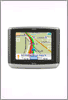
Garmin's recently (and abruptly) announced handset obviously marks the firm's first solo foray into the cellphone arena, and according to Cliff Pemble, the firm's president and COO, it's the "breakthrough product that cellphone and GPS users around the world have been longing for." That being said, the unit will feature a 3.5-inch touchscreen with a trio of primary icons -- Call, Search and View Map -- along with an internet browser, HSDPA support and preloaded maps of North America and / or Eastern and Western Europe. Furthermore, it houses "millions" of POIs, doles out turn-by-turn, voice-prompted directions and becomes Garmin's first device to include Google's local search capability. As for pricing and availability? We're looking at a Q3 2008 release, but we'll have to wait things out before finding out a price and who exactly will be carrying it.

In case that wasn't enough, here's an overview of the rest of the features:

* "Where am I?" - spits out precise longitude / latitude coordinates at a moment's notice
* Helps drivers remember where they parked by marking the position in which it was last removed from the vehicle mount
* Garmin Online - an online service offering constantly updated information such as real-time traffic, fuel prices, stock prices, sports scores, news reports, local events and weather forecasts
* Built-in camera (megapixels currently unknown; captures video as well) that automatically tags photos with exact longitude / latitude. This allows the user to navigate back to the location or email the image to a recipient who can navigate directly to its location.
* Provides direct access to millions of geo-located landmark and sightseeing photographs available through Google's Panaramio picture sharing site
* Integrated media player to handle MP3, MPEG4 and AAC files
* Just in case you missed it: Q3 2008 release; price and "sales partners" will be announced "in the future"

Labels: ,

Sunday, January 20, 2008

Garmin's new Forerunner 405 puts the 'watch' back in 'GPS watch'

Starting with the Forerunner 305, Garmin finally started producing GPS-enabled watches that didn't make you look like a total goof while tracking your pace and vitals, but these still weren't timepieces you'd be comfortable wearing to the office or even a bar. Then came the Forerunner 50, which had the perfect watch-like form factor, but unfortunately, no GPS. So fans of this line will be pleased to learn that Garmin has somehow been able to shoehorn a satellite receiver into a casing not much bigger than the 50's and dubbed it the Forerunner 405.

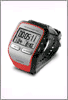
Besides monitoring and logging speed, distance, heart rate and location, the 405 also features a touch-sensitive bezel for controlling its various functions, as well as the same proprietary ANT+Sport wireless syncing technology as the GPS-less 50. Available in either black (pictured above) or green (pictured after the break, along with a video walkthrough), the Forerunner 405 will start at $299.


Labels: , ,

Thursday, September 27, 2007

Garmin® Introduces Forerunner 50

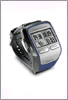
Garmin introduces Forerunner50 as only sports watch with automatic wireless sync. Forerunner 50 is an affordable, sleek and intelligent way to help runners and walkers track their workouts, automatically store their data and reach their personal fitness goals. The announcement strengthens Garmin’s role as an innovation leader in the fitness world and reinforces the company’s commitment to enriching its customers’ lives.

The principle: You simply call the telephone number of the GPS PRO Dog collar with your handy /mobile phone /cell phone. The GPS receiver of the collar, estimates the position of the dog and sends the coordinates immediately as SMS (Short Message service) over the Global System for Mobile Communication (GSM) directly on your mobile phone display. The accuracy of the positioning amounts to the average less than 15 meters.

The central element of the Forerunner 50 system is an advanced fitness watch which interfaces wirelessly with other fitness devices such as a heart rate monitor or a foot pod that monitors speed and distance. The system includes a wireless USB ANT™ Stick that plugs into the user’s PC and automatically downloads workout data stored on the watch to a personal computer. No cables are necessary as the Forerunner 50 synchronizes with the computer once it is in close proximity. Depending on the model purchased, the Forerunner 50 accurately monitors and records heart rate or speed and distance or all of the above. The workouts themselves are made easier with the Forerunner 50 as its heart rate monitor and foot pod activate automatically upon movement, removing the need to turn the lightweight accessories on and off.

With this entry-level fitness watch priced at under $100, Garmin broadens its appeal to the millions of consumers who want to burn calories in a cost-effective manner. While the Forerunner 50 processes much of the same data as its GPS-enabled predecessors, those functions are packaged in a very compact device the size of a typical fitness watch. The Forerunner 50 can track and record up to seven hours and 100 laps of detailed exercise data. And because the Forerunner 50 records its data from the heart rate monitor and foot pod, users can exercise indoors — for example, accurately monitoring their heart rate while on a treadmill or tracking how far they walk each day in the office. The foot pod enables the Forerunner 50 to track and record speed, distance, cadence, steps and calories burned. Cycling enthusiasts will enjoy the versatile options of adding a bike speed and cadence sensor and a handy bike mount
.

The Forerunner 50 will be sold in a few different combinations, some with the foot pod, some with a heart rate monitor, and all will come with a wireless USB stick so that information can be downloaded wirelessly from the watch to the USB stick and then into your computer.


Labels: , , , ,